
Best vr exploration games 2026 is less about chasing the newest trailer and more about finding worlds that feel worth inhabiting, especially when you only have an hour and you don’t want it wasted on janky locomotion or empty scenery.
A lot of “exploration” in VR still hides a mismatch: you want discovery and presence, but you end up fighting motion sickness settings, unclear objectives, or a world that looks big yet feels dead. The good news is that the category is finally branching into distinct sub-genres, and once you know which type you like, picking becomes much easier.
In this guide, I’m going to break exploration VR into practical buckets, give you a quick self-check to avoid buying the wrong vibe, and share a curated short list that’s easier to shop than a giant, unranked dump.
What “exploration” means in VR (and why it matters)
Exploration is a word storefronts love because it sounds universal, but players usually mean one of a few things. If you don’t separate them, recommendations get messy fast.
- Narrative wandering: you explore to uncover story, environmental clues, and set pieces, pacing matters.
- Systems sandbox: you explore to survive, craft, scan, or build, the world pushes back.
- Pure sightseeing: you want presence, scale, and mood with minimal friction.
- Traversal-first: climbing, swinging, swimming, and movement mastery is the fun.
One more thing: comfort settings are part of exploration in VR. A beautiful world becomes a refund if turning and acceleration feel rough for your body.
According to Meta (Quest comfort guidance), comfort features like teleport options, vignetting, and snap turning can reduce discomfort for many players, so it’s worth treating those settings as “must-check” features, not a nice-to-have.
Quick self-check: which exploration vibe fits you?
If you’re buying for yourself, answer these honestly. If you’re gifting, ask the person, it saves everyone time.
- I get motion sick easily → prioritize teleport, snap turn, and slower pacing.
- I hate being told where to go → look for open zones, scanning tools, and optional objectives.
- I want a story payoff → choose narrative exploration with environmental storytelling.
- I enjoy “hands busy” gameplay → survival/crafting exploration will land better than sightseeing.
- I mostly play in short sessions → pick hub-based or chapter-based exploration over sprawling survival loops.
Also, be real about your play space. Room-scale movement feels amazing, but many households end up playing standing or seated a lot of the time.
Best VR exploration games 2026: curated picks by style
This list leans on what typically makes exploration feel good in VR: readable navigation, strong environmental variety, and interaction that justifies being in VR. Availability and platform support can change, so treat this as a shortlist to verify on your store of choice.
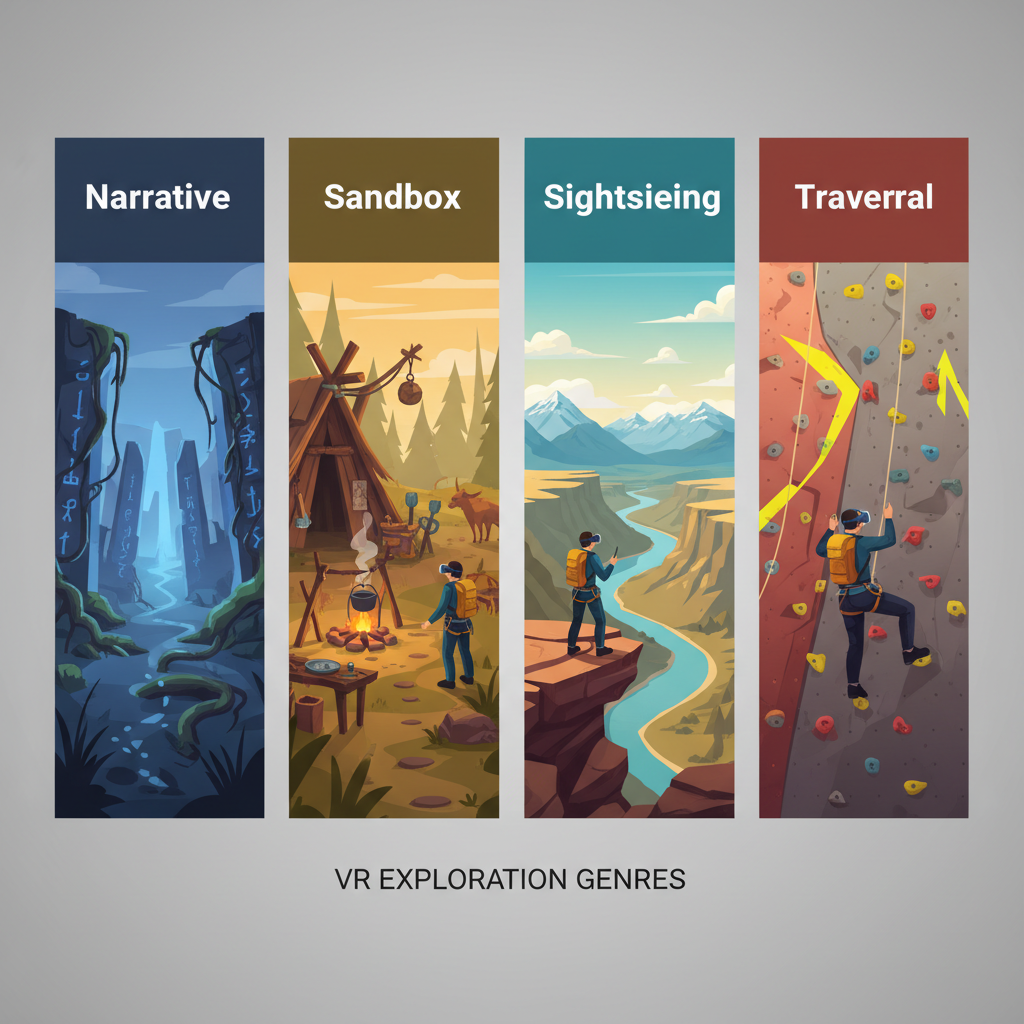
Narrative-first exploration
- The 7th Guest VR: puzzle-driven mansion exploration, great for players who like uncovering secrets room by room.
- Red Matter 2: sci-fi atmosphere, strong set pieces, a “walk around and absorb it” pace that still feels like a game.
- The Room VR: A Dark Matter: tactile puzzling with elegant environments, ideal if you want curated discovery rather than open-world sprawl.
World-scale sandbox exploration
- No Man’s Sky (VR mode): vast procedural universe, best if you enjoy scanning, upgrading, and long-form wandering.
- Subnautica (VR with community mods, where applicable): ocean exploration that’s unforgettable, but comfort and setup vary by platform, so check your tolerance and configuration options.
Sightseeing and “presence” exploration
- Google Earth VR: still one of the most convincing “go anywhere” experiences on PC VR, especially for casual exploration.
- Walkabout Mini Golf: not a traditional explorer, but the course worlds are quietly some of the best bite-sized sightseeing in VR.
Traversal-heavy exploration
- The Climb 2: vertical exploration, strong sense of height and place, excellent when you want movement to be the point.
- Hubris: action-forward, but the environments and traversal beats scratch that “push into the unknown” itch.
Comparison table: pick fast without overthinking
If you’re scanning for a purchase decision, this is the section to bookmark.
| Game | Exploration Style | Comfort Notes | Best For |
|---|---|---|---|
| Red Matter 2 | Narrative / atmospheric | Usually solid comfort options | Story + visuals, slower pace |
| No Man’s Sky (VR) | Sandbox / procedural | Continuous movement common | Long sessions, upgrading loops |
| Google Earth VR | Sightseeing | Can feel intense at first | Travel, scale, casual discovery |
| The Climb 2 | Traversal / climbing | Arm fatigue possible | Movement mastery, vertigo thrills |
| The Room VR | Puzzle exploration | Comfort-friendly in many setups | Tactile puzzles, guided discovery |
How to choose (practical steps that save refunds)
Here’s the buying workflow that tends to work, even if you’re not “a VR person.”
- Watch 2 minutes of raw gameplay, not a trailer. Trailers hide locomotion and comfort settings.
- Check movement options: teleport vs smooth, snap turn vs smooth turn, seated mode support.
- Read one critical review that mentions comfort, bugs, and pacing, not just visuals.
- Match session length: if you play 20–30 minutes at a time, massive sandboxes can feel like chores.
- Confirm platform support and recent update status, especially for PC VR titles with mods.
Key takeaway: the “best” pick is usually the one whose locomotion you can tolerate and whose pacing fits your real life, not your weekend fantasy.
Comfort and safety: explore longer without feeling awful
Exploration often involves movement, height, and smooth turning, which can trigger discomfort for some players. If you’re sensitive, ease in rather than powering through.
- Start with teleport and snap turning, then experiment with smooth locomotion later.
- Use a fan pointed at your play space, a lot of people find airflow helps orientation.
- Take breaks early if nausea shows up, trying to “push through” can make future sessions harder.
- Clear your boundary, especially for climbing and room-scale titles, wrists and controllers meet furniture faster than you expect.
According to Mayo Clinic, motion sickness can be triggered by conflicting signals between what you see and what your inner ear senses, and practical measures like breaks and avoiding triggers can help. If symptoms feel intense or persistent, it’s reasonable to consult a clinician.
Common mistakes when shopping the best vr exploration games 2026
These are the traps that show up repeatedly, even for experienced players.
- Buying “open world” and expecting constant wonder: many open worlds have repetition, VR makes repetition more noticeable.
- Ignoring comfort labels: “moderate” or “intense” comfort ratings aren’t moral judgments, they’re practical warnings.
- Over-indexing on graphics: a gorgeous world with weak interaction can feel like a museum you can’t touch.
- Forgetting friction: inventory, crafting, and scanning are fun only if you enjoy systems, otherwise it’s busywork.
Conclusion: a simple way to lock your next pick
If you want a reliable shortcut, choose one title from a style you already like, then one “adjacent” style to expand your taste without risking a total mismatch. That’s how most people build a VR library that actually gets played.
If you’re shopping the best vr exploration games 2026 for someone else, default to comfort-friendly narrative exploration or sightseeing, it’s usually the safest first step, then graduate into sandbox or traversal once they know what their stomach and their schedule can handle.
FAQ
- What counts as an exploration game in VR?
Usually it means the world itself is the reward, you’re moving through spaces to discover story, sights, tools, or secrets, not just chasing combat encounters.
- Are the best vr exploration games 2026 better on Quest or PC VR?
It depends on what you value. PC VR often offers higher fidelity and bigger worlds, while Quest-native titles tend to be simpler to launch and easier to play in short sessions.
- Which VR exploration games are most comfortable for beginners?
Puzzle-led and slower narrative exploration often feels easier because movement is calmer and interactions are more deliberate, so your body adapts without constant acceleration.
- How do I avoid motion sickness in exploration-heavy VR?
Use teleport and snap turning at first, play in shorter bursts, and stop when symptoms start. If it keeps happening across multiple titles, consider asking a professional for guidance.
- Do exploration games need combat to stay interesting?
Not really. Many people stick with exploration titles because atmosphere, puzzles, traversal, and story reveals create momentum without fights, combat is just one tool.
- What should I check before buying a VR exploration game?
Movement options, recent updates, and real gameplay footage matter more than screenshots. If you can’t tolerate the locomotion, the world won’t matter.
- Is No Man’s Sky a good “first” exploration VR game?
It can be, but it’s also a big systems sandbox, which some players love and others bounce off. If you enjoy upgrading and crafting loops, it’s a strong fit.
If you want a more personalized shortlist
If you’re torn between two styles or you’re buying for someone with comfort concerns, it often helps to shortlist based on headset, play space, and motion tolerance first, then pick the world you like. If you tell me your platform and what kind of exploration you enjoy, I can narrow it to a few low-regret options.